- ScholarSphere Newsletter
- Posts
- ScholarSphere Newsletter #4


Welcome to ScholarSphere Newsletter #4
Greetings, esteemed readers, and welcome to our AI Newsletter—a premier destination for navigating the intricate landscape of AI within academia.
What we’ll Learn Today
(Dis)Information: Artificial Intelligence Unleashed
Presented by Zachary Adams
Artificial Intelligence (AI) is having a mind-boggling effect upon how content is created and spread. In this course we will dive into the world of AI and explore how it is shaping the information people consume, the news they trust (or not), and the way they learn.
April 12: Zachary Adams will demystify AI’s role in media, discuss its influence on news credibility, and unveil how AI is redefining education. This session will help participants understand AI’s impact, evaluate AI in daily life, and apply AI insights through real-world examples and hands-on experience with AI tools.
April 19: This “open forum” is designed to take course participants’ understanding of AI to the next level through asking questions, sharing experiences and insights, and delving deeper into AI’s impact on daily life. We will consider the latest AI developments, discuss complex ethical considerations, and explore the seemingly endless possibilities for AI that lie ahead.
Mastering AI: Prompt Perfection #3
Training #3: Streamlining and Refining Your Bibliography with AI
Organizing a bibliography can be a daunting task, especially when dealing with multiple citation styles and a large number of references. Also when a bibliography is created with one style and now you need to convert it to another. Using AI tools efficiently can save time and ensure your bibliography meets academic standards.
🎯Objective: Refine your bibliography to be clean, consistent, and compliant with specific citation style guidelines using AI tools.
👶 Rookie Prompt: "Fix this bibliography."
❌ Why This Falls Short: This request is too vague and does not provide AI with enough context or specific instructions. The lack of detail can lead to an improperly formatted bibliography that may not comply with the required citation style or overlook important inconsistencies and errors.
🧙 ScholarScript: "Organize and format this bibliography according to the APA/MLA/Chicago (choose appropriate style) citation guidelines. Ensure all entries are complete with authors, year, title, and source. Check for and correct any inconsistencies in punctuation, capitalization, and italicization. Identify any entries missing critical information such as publication dates or DOI numbers. Remove duplicate entries and format all web links as per the style guide. Include a check for proper alphabetical ordering as per last names of first authors. Please generate a report highlighting changes made and any issues that require manual review."
✅ Why It Works Wonders: This detailed prompt directs the AI to focus on specific aspects of bibliography refinement crucial for academic rigor. It explicitly requests adherence to a chosen citation style, which is fundamental for academic writing. The prompt also asks for a comprehensive check on common issues such as missing information, duplication, and incorrect ordering, which are typical in a messy bibliography. We asked ChatGPT to fix a messy bibliography using the two prompts. Comparing the outputs of the two, it's clear that the more detailed ScholarScript prompt yields a more organized and accurate bibliography. This approach enhances the consistency and completeness of citations by addressing missing data, ordering, and punctuation issues. The final result aligns with academic style guidelines while providing a thorough report for further review. In contrast, the vague rookie prompt results in inconsistent and incomplete formatting.
By ensuring high accuracy and compliance, the detailed prompt elevates the reliability of the bibliography and educates the researcher on maintaining these standards in future work.
See it in action through this sample ChatGPT conversation:
Rookie Prompt Example
ScholarScript Chat Example
Here is a comparison made by ChatGPT showing the strengths of the ScholarScript output.
Cutting-Edge AI Insights for Academia

Powered by Copilot, DALLE 3
How professors are using and teaching with generative AI: Academic Success Tip: Infusing AI into Curricular Offerings
The Spread of Artificial Intelligence in Academia by Karuna Namala & Amber Guerrero
Local news highlights UC's artificial intelligence programs UC offers three degree programs in AI
UT Partners With Grammarly to Guide Effective Generative AI Use in Higher Education
Bermudian academic receives grant to study AI use in schools
How will artificial intelligence affect the teaching sector?
Spotlight on AI Tools for Academic Excellence

Chegg: The evolution of 24/7 study starts here, textbook rentals, online tutoring, homework help, scholarship searches, and internship matching
Copyai: Generating copy and content across various formats, including social media posts, advertising copy, blog content, product descriptions, and more
Heuristi.ca : Learning & Research Made Simpler, AI-powered mind maps and concept maps for visual learning, thinking and research.
Popai: Your Personal AI Workspace, AI Assistant, Document Interaction, Content Creation such as PowerPoint slides, mind maps, and images based on user prompts or topics
Sourcely: Finish Your Research in Minutes, automated referencing robot that can cite written work accurately and in real-time
Academic Frontiers: Exploring AI Innovations
2024 AI+Education Summit: What do Educators Need from AI? Stanford HAI
The 2024 AI+Education Summit, hosted by the Stanford Institute for Human-Centered Artificial Intelligence (HAI) and the Stanford Accelerator for Learning on Feb. 1, addressed how AI can transform teaching and learning in an ethical, equitable, and safe manner; what metrics of assessment, fair evaluation, and overall regulatory framework are required to deliver these qualities; and how to build AI for education and with educators.
In this panel, experts discuss what teachers really expect from these tools, and how prepared school districts are to assist.
Speakers
Amanda Bickerstaff: Co-Founder and CEO, AI for Education
Keith R. Krueger: CEO, Consortium for School Networking (CoSN) Victor Lee: Associate Professor of Education, Stanford University
Pat Yongpradit: Chief Academic Officer, Code.org
Moderator: Glenn Kleiman, Senior Advisor, Stanford Accelerator for Learning
Learn about upcoming Stanford HAI events: https://hai.stanford.edu/events
Navigating Ethical Frontiers: AI and Ethics
AI Will Change What It Means To Be Human: Overview of a discussion
Professor Michael Sandal, the well-known political philosopher, discussed the anxiety surrounding technology's influence on what it means to be human. He asked the audience if they would consider getting an AI companion robot for a lonely relative. The opinions were divided on whether AI could provide meaningful companionship. Another aspect discussed was the bias in AI, which stems from the subjectivity of human decision-making. While AI is seen as objective, it replicates biases present in data, raising concerns about its impact on hiring practices. The conversation also delved into the loss of the distinction between what's real and what's fake due to AI advancements. The potential consequences of becoming indifferent to this distinction were highlighted. Transparency and surveillance in the digital world were also seen as potential barriers to human freedom and autonomy. Sandal concluded by emphasizing the need for humility in the face of technological advancements, as it is essential for addressing the excesses of technocratic conceits and polarized public life.
Engage and Learn: AI Workshops & Seminars
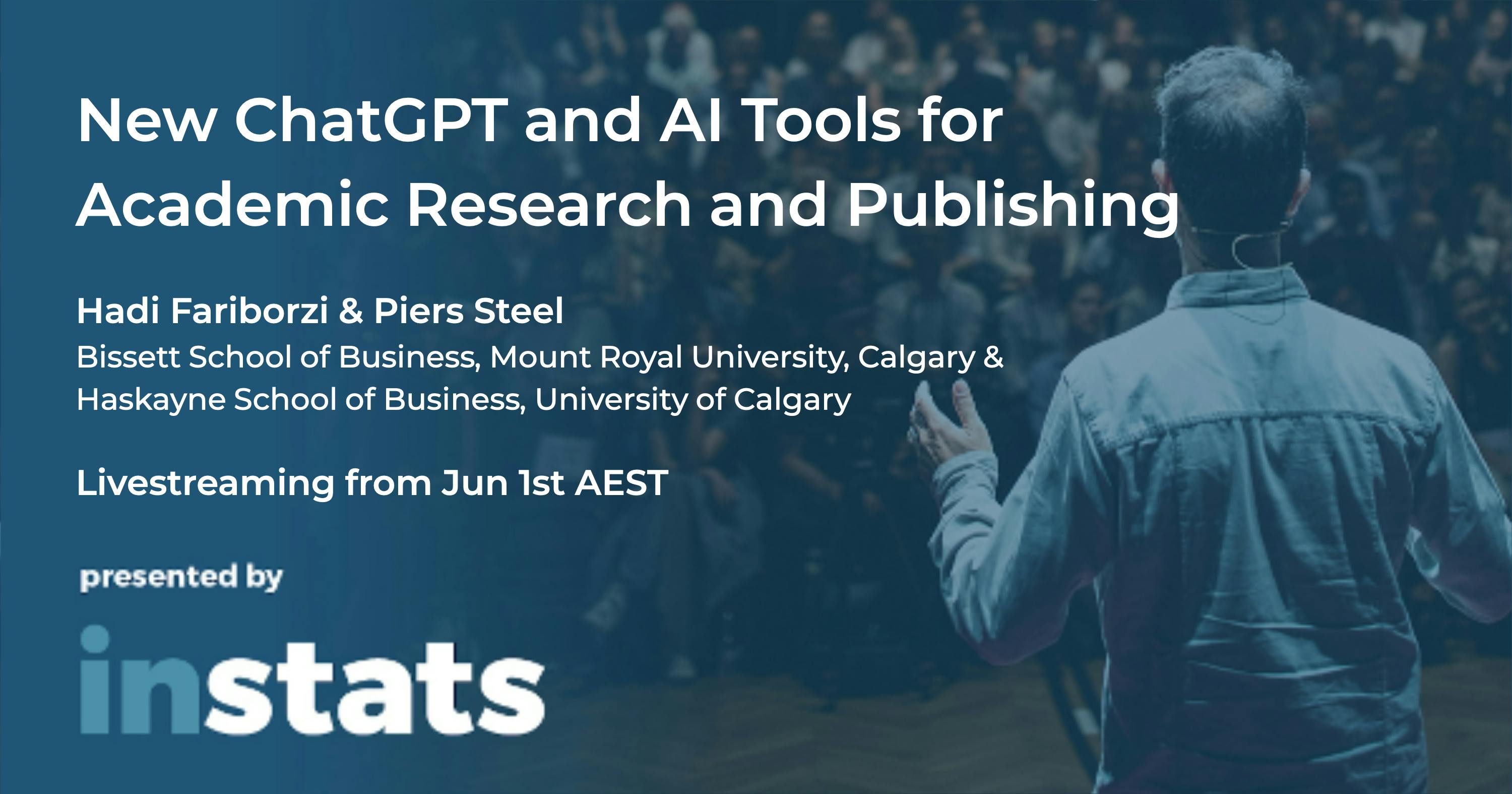
🎓 Featured Seminar: New ChatGPT and AI Tools for Academic Research and Publishing
Join professors Piers Steel and Hadi Fariborzi for a new seminar that covers recent developments in generative AI for academic research and publishing. This half-day seminar offers both newcomers and experienced AI users an unparalleled opportunity to quickly up-skill and re-skill by incorporating the latest AI advancements into the academic research and publishing process. Register for this seminar to stay at the forefront of academic innovation, effortlessly integrating the newest AI tools and techniques as digital research assistants for your scholarly work.
📅 Date: Live Session Begins May 31, 2024
⏰ Time: Live streaming 1-Day Seminar
Day 1: May 31st from 7:30 pm to 11:30 pm*
*All times are in your local time zone.
📍 Location/Online Platform: The live-stream sessions are done on Zoom
Secure your spot now and mark your calendar for an enlightening experience you won't want to miss!
#MondayMotivation - Looking to improve your skills this week? Then we have the #workshop for you! Join our very own Jay Miller this Wednesday to learn how to prepare your existing content for AI using LangChain and store it in OpenSearch®. Register now: ow.ly/aXZy50Rx2Yt
— Aiven (@aiven_io)
7:36 AM • May 6, 2024
Free on-line Workshop in English, "Practical Philosophy, Generative AI, and Coaching" at 9:00-10:30am on May 12th in JST (GMT+9) #amebaownd
— Coaching Evangelist/Thought Leader/Ph.D (@aki_morita)
6:42 AM • May 6, 2024
And that's a wrap for this edition of our AI Newsletter! We've covered a lot of ground, but remember, the adventure doesn't stop here. Keep exploring, keep learning, and keep pushing the boundaries of what's possible with AI. If you want to contact editorial team for having your news, tool, website, X page, or even yourself! introduced in our newsletter you can find contact info just below.
Reply