- ScholarSphere Newsletter
- Posts
- ScholarSphere Newsletter #7

Welcome to 7th edition of ScholarSphere
"Truth surfaces when the waters recede."
With the announcement of the new AI models, it is crucial to prepare for their integration into various tools. Lets take this opportunity to enhance our understanding!
Greetings and welcome to our ScholarSphere AI Newsletter, your premier resource for navigating the dynamic landscape of AI in academia. If you have not joined us yet, seize the opportunity now! Simply click the button, register with your email, and prepare for an enlightening journey through all facets of AI in education!
In today's search of AI, we'll see...
Deep Dive into AI: Expand Your Knowledge
With Spatial Intelligence, AI Will Understand the Real World
By Fei-Fei Li | TED
In the beginning of the universe, all was darkness — until the first organisms developed sight, which ushered in an explosion of life, learning and progress. AI pioneer Fei-Fei Li says a similar moment is about to happen for computers and robots. She shows how machines are gaining "spatial intelligence" — the ability to process visual data, make predictions and act upon those predictions — and shares how this could enable AI to interact with humans in the real world.
Mastering AI: Prompt Perfection

Training 5: Formatting your bibliography
Correctly formatting your bibliography is essential for academic writing, ensuring that your sources are properly cited and easily identifiable. At the same time it is one of the most time consuming tasks in writing, prone to numerous mistakes and inconsistencies. Using reference managers such as Zotero is a big leap, but even then the work is usally not 100% and lots of checks is required in the end. Let’s see how we can use ChatGPT to help, with the example of APA 7 style which is widely used in the social sciences.
🎯Objective: Learn to format bibliographies accurately in APA 7 style (or any other style you need them in), ensuring that all sources are cited correctly, maintaining academic integrity, and enhancing the readability of your scholarly work.
Note of Warning on Plagiarism: Proper citation is crucial to avoid plagiarism. Failing to correctly attribute ideas and findings to their original sources undermines the credibility of your work and violates ethical standards. Ensure that every source you consult is properly cited in your bibliography.
👶 Rookie Prompt: "Format this bibliography in [APA 7 style]."
❌ Why This Falls Short: This request is too vague and does not provide enough context for the AI to deliver accurate results. It lacks details such as the type of source (e.g., book, journal article, website), which are essential for proper formatting. Assuming that “AI knows” is one common mistake and an example of poor usage of AI. The AI might produce an incomplete or incorrect reference, leading to potential issues with academic integrity. 🧙 ScholarScript: "Format the following references in APA 7 style. Here is a detailed guideline for formatting references:
1. Basic format for Books: Author(s). Year of publication in round brackets. Book title in italics. Edition in round brackets, if other than first. Publisher. DOI (if available). The first line of each citation is left adjusted. Every subsequent line is indented 5-7 spaces.
2. Basic format to reference Journal Articles: Author(s). Year of publication in round brackets. Article title. Journal title in italics. Volume of journal in italics. Issue number in round brackets (no italics). Page range of article. DOI or URL (if available). The first line of each citation is left adjusted. Every subsequent line is indented 5-7 spaces. Example: Ruxton, C. (2016). Tea: Hydration and other health benefits. Primary Health Care, 26(8), 34-42. https://doi.org/10.7748/phc.2016.e1162.
3. Basic format to reference Conference Proceedings: Author(s). Year of publication. Title of the paper. Editors of the conference proceedings. Title of conference proceedings in italics. Pages of the paper in round brackets. Publisher. DOI or URL (if available). The first line of each citation is left adjusted. Every subsequent line is indented 5-7 spaces. Example: Rudawska, A. (2020). Knowledge sharing and creativity: Individual and organizational perspective. In A. Zakrzewska-Bielawska & I. Staniec (Eds.), Contemporary challenges in cooperation and coopetition in the age of industry 4.0: 10th Conference on Management of Organizations' Development (MOD) (pp. 107-121). Springer. https://doi.org/10.1007/978-3-030-30549-9_5.
4. Basic format to reference A Webpage on A Website: Author(s). Year, Month Day in round brackets. Title in italics. Website name. URL. The first line of each citation is left adjusted. Every subsequent line is indented 5-7 spaces. Example: Johnson, A. (2018, May 24). “It doesn’t need to be this way”: The promise of specialised early intervention in psychosis services. IEPA. https://iepa.org.au/network-news/it-doesnt-need-to-be-this-way-the-promise-of-specialised-early-intervention-in-psychosis-services."
✅ Why It Works Wonders: This detailed prompt guides the AI to format each type of source accurately according to APA 7 style. By specifying the type of source and providing all necessary details, it ensures that the AI includes all required elements in the correct format. This approach minimizes errors and ensures that your bibliography meets academic standards, enhancing the credibility and professionalism of your work.
Full getting access to our Prompt Inventory click here
Cutting-Edge AI Insights for Academia

By DreamyIsla, Gencraft
How close are we to AI that surpasses human intelligence?
What Is Artificial General Intelligence (AGI)? Artificial general intelligence blurs the line between human intelligence and machine intelligence.
Uncharted Territory: Artificial General Intelligence and Higher Ed
REDDIT Time: In an AGI world where intelligence is virtually no longer required from humans, with jobs replaced or ended, would people still go to university? what will remain of higher education if studying is no longer required cause working is no longer required?
Article of the Week: The risks associated with Artificial General Intelligence: A systematic review
Spotlight on AI Tools for Academic Excellence

Explainpaper: The Fastest Way to Read Research Papers, Upload a paper, highlight confusing text, get an explanation. We make research papers easy to read.
Hix.ai: Offers an AI text generator, AI Writer, an AI chatbot – HIX Editor, an all-in-one Chrome extension and Chrome Extension, a Long-Form Blog Generator and an Email Generator.
lovo.ai: An AI-powered text-to-speech platform that allows users to generate realistic-sounding voices for a variety of applications, such as voiceovers, podcasts, and virtual assistants.
Nextnet: A cloud-based platform where scientists discover hidden connections from disparate data, generate hypotheses, and make decisions together.
SMMRY: Summarize articles, text, websites, essays and documents for free
Academic Frontiers: Exploring AI Innovations
Reflecting on a Half Year of AI Innovation | 06x12
By Gestalt IT
We knew that 2024 would be the year of AI right from the start, but this season of the podcast has seen incredible development and change. This final episode of Utilizing Tech Season 6 features hosts Frederic Van Haren, Allyson Klein, and Stephen Foskett discussing the current state of AI infrastructure half-way through 2024.
In addition to AI Field Day, we experienced NVIDIA GTC and numerous product introductions over the last few months. It's truly an ecosystem play now, with every company showing how well they can partner to build AI infrastructure. At the same time, a few superusers of AI are responsible for the basic models, including Google, Amazon, and Microsoft, and of course OpenAI and the other dedicated generative AI firms. The key to bringing this to the enterprise market is transfer learning, which will see a few base models tuned and trained for specific use cases. This season saw a range of guests discussing storage, data platforms, connectivity, and application development, and every one is focused on delivering practical AI solutions in the enterprise.
Hosts: Stephen Foskett, Allyson Klein, & Frederic Van Haren
Accountability in Artificial Intelligence: A review
By Novelli, C., Taddeo, M., & Floridi, L.
"Accountability in Artificial Intelligence: What It Is and How It Works" by Novelli, Taddeo, and Floridi discusses the issue of accountability in AI governance.
The authors argue that accountability is often undefined due to the multifaceted nature and sociotechnical structure of AI systems, which can hinder public debate and policymaking.
They define accountability as answerability, with three conditions: authority recognition, interrogation, and limitation of power.
They also propose seven features of accountability: context, range, agent, forum, standards, process, and implications.
In addition, The article analyzes four goals of accountability: compliance, report, oversight, and enforcement. The authors emphasize the need for a sociotechnical approach to accountability, considering the interaction between technology and social components.
Finally, the article applies the framework to AI, discussing proactive and reactive accountability and governance missions. The authors emphasize the complexity and importance of ensuring accountable AI systems and offer valuable insights for policymakers and stakeholders in the AI governance landscape.
Novelli, C., Taddeo, M., & Floridi, L. (2023). Accountability in artificial intelligence: What it is and how it works. AI & Society.
For More Detailed summary please visit our LinkedIn page
For the main article click here
Engage and Learn: AI Workshops & Seminars
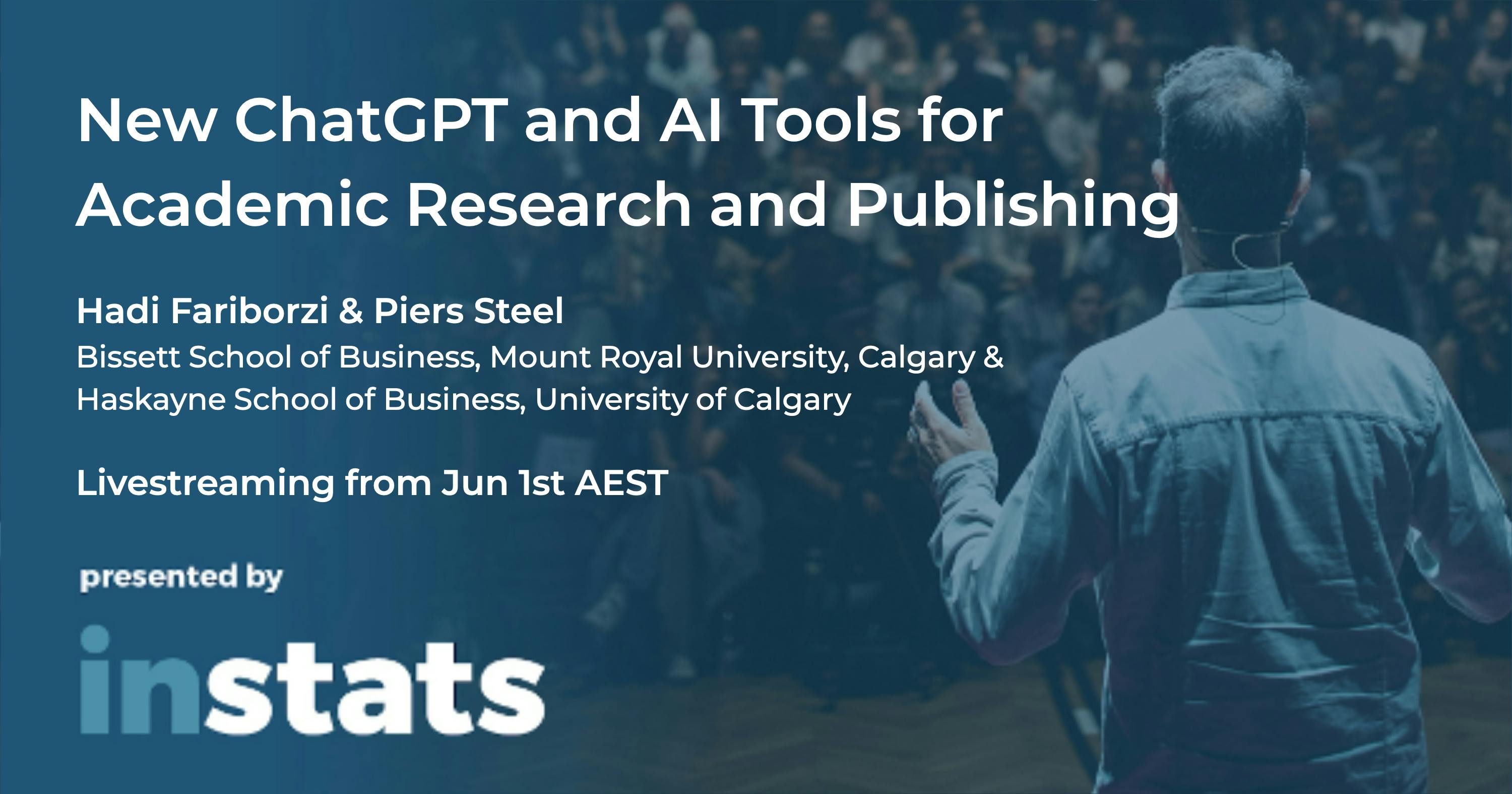
🎓 Featured Seminar: New ChatGPT and AI Tools for Academic Research and Publishing
Join professors Piers Steel and Hadi Fariborzi for a new seminar that covers recent developments in generative AI for academic research and publishing. This half-day seminar offers both newcomers and experienced AI users an unparalleled opportunity to quickly up-skill and re-skill by incorporating the latest AI advancements into the academic research and publishing process. Register for this seminar to stay at the forefront of academic innovation, effortlessly integrating the newest AI tools and techniques as digital research assistants for your scholarly work.
📅 Date: Live Session Begins May 31, 2024
⏰ Time: Live streaming 1-Day Seminar
Day 1: May 31st from 7:30 pm to 11:30 pm*
*All times are in your local time zone.
📍 Location/Online Platform: The live-stream sessions are done on Zoom
Secure your spot now and mark your calendar for an enlightening experience you won't want to miss!
Call for paper! For the "#TempXAI: Explainable AI for Time Series and Data Streams Workshop"! It is hosted as part of this year's @ECMLPKDD 2024 conference in Vilnius. The Paper Submission deadline is June 22, 2024!
➡️More details: sites.google.com/view/tempxai-w…
— RC Trustworthy Data Science and Security (@RCTrustworthy)
10:16 AM • May 14, 2024
Build a LLM app with RAG to chat with GitHub using Llama-3 running locally on your computer (100% free and without internet):
— Shubham Saboo (@Saboo_Shubham_)
2:27 AM • May 19, 2024
And that's a wrap for this edition of our AI Newsletter! We've covered a lot of ground, but remember, the adventure doesn't stop here. Keep exploring, keep learning, and keep pushing the boundaries of what's possible with AI. Together, we're shaping the future of academia one breakthrough at a time. Until next time, stay curious and keep shining bright! ✨. If you want to contact editorial team for having your news, tool, website, X page, or even yourself! introduced in our newsletter you can find contact info just below.
Reply