- ScholarSphere Newsletter
- Posts
- ScholarSphere Newsletter #8

Welcome to 8th edition of ScholarSphere
“Spontaneous is Beautiful, Repetitious is Everywhere!”
Welcome aboard our AI Newsletter—the go-to destination for navigating the ever-evolving landscape of AI in academia. If you haven't hopped on the bandwagon yet, now's the time! Hit that button, sign up with your email, and buckle up for a wild ride through all things AI in academics!
In today's search of AI, we'll see...
Deep Dive into AI: Expand Your Knowledge
AI Jobs Salary Guide 2024
By Aminu Abdullahi

Image: Vadym/Adobe Stock
Artificial intelligence jobs offer promising salary prospects for individuals with a passion for technology and a commitment to advancing their skills in AI. As AI continues to gain momentum, skilled professionals will remain in high demand, making AI careers not just intellectually fulfilling but also financially rewarding. Our AI jobs salary guide analyzes various AI roles and their average compensation to help you understand the earning potential of each role.

For reading the full article click here.
You can also find extra teaching articles in our LinkedIn Page.
Mastering AI: Prompt Perfection #6

Training 6: Enhancing AI Utilization with Factored Cognition
Correctly utilizing AI for research tasks can dramatically improve efficiency and accuracy. However, effective use of AI requires precise prompting and understanding of how to guide AI to achieve desired outcomes. Factored cognition is a powerful technique that helps break down tasks into detailed steps, enhancing the AI's performance and ensuring high-quality results.
🎯Objective: Learn to utilize factored cognition to guide AI effectively in research workflows, ensuring precise and efficient outcomes. ---
🔏Note on Plagiarism: Using AI to assist with research must adhere to ethical guidelines. Ensure proper attribution and avoid presenting AI-generated content as entirely your own work. Transparency and integrity are crucial.
👶 Rookie Prompt: "Produce an abstract for this paper."
❌ Why This Falls Short: This broad prompt can lead to vague or incomplete results, lacking the specific focus required for high-quality academic work.
🧙 ScholarScript: "Act as an expert in [the field]. Extract key goals, identify significance, state the research question, outline theories, summarize methods, highlight key results, and combine these elements into a comprehensive abstract."
✅ Explanation: Detailed, step-by-step instructions guide the AI, ensuring the output is precise and relevant. This method enhances the control researchers have over the AI’s performance, improving the quality and accuracy of the results.
Implementing Factored Cognition
Step-by-Step Guide:
Break Down Tasks: Identify the main components of the task.
Specify Details: Clearly outline each component.
Construct Pro Prompts: Combine these detailed instructions into a comprehensive prompt.
Example Conversion:
🎯Objective: Generate a literature review.
👶 Rookie Prompt: “Write a literature review on gender wage gap.”
🧙 ScholarScript: “Identify key studies on gender wage gap. Summarize findings, methodologies, and theoretical frameworks. Highlight gaps in the research and suggest areas for future study.”
📝 Practice Exercise: Try converting your broad tasks into factored prompts. For instance, if your task is to analyze survey data, break it down into steps: cleaning data, running specific analyses, interpreting results, and summarizing findings.
✅ Benefits of Factored Cognition
Enhanced Control: Retain more control over AI outputs.
Improved Accuracy: More precise instructions lead to better quality results.
Efficiency: Save time on revisions and focus on critical research tasks.
🔏 Ethical Considerations
Transparency: Always disclose the extent of AI’s involvement in your work.
Accountability: Verify AI-generated content thoroughly to ensure accuracy and integrity.
📤 Conclusion
Factored cognition transforms how researchers utilize AI, leading to more precise, efficient, and ethically sound outputs. By mastering detailed, step-by-step prompting, researchers can significantly enhance their productivity and maintain high standards in their academic work.
This training module provides practical insights and hands-on experience, aligning with ScholarSphere’s commitment to advancing ethical and effective AI practices in academia.
Full getting access to our Prompt Inventory check here
Don’t forget to visit our LinkedIn Page
Cutting-Edge AI Insights for Academia

The Seven Levels of Human Capability
43 Examples of Artificial Intelligence in Education
When AI Helps Generate Inventions, Who Is the Inventor?
The Impact of Artificial Intelligence on Innovation
Article of the Week: Using artificial intelligence in academic writing and research: An essential productivity tool
Spotlight on AI Tools for Academic Excellence

HeyGPT: Unlock advanced functionalities such as chat with multiple pdfs at once, using ChatGPT with text-to-speech, speech recognition, chat search, tagging your chats and more.
LanguageTool: An AI-based spelling, style, and grammar checker that helps correct or paraphrase texts across languages.
Thepagedoctor: An online platform that caters to students seeking academic editing and support. They connect students with current PhD researchers or holders who act as "PageDoctors," providing proofreading, personalized feedback, and even 1-on-1 consultations on academic work like essays, dissertations, and theses.
rytr.me: An AI-powered content generator and writing assistant tool that can help you create various types of content, such as website copy, marketing and sales copy, social media captions, and more.
Summarizer.org: A free summary generator that can instantly summarize any text, articles and essays with the best key points.
Academic Frontiers: Exploring AI Innovations
"The Impact of AI: Amplifying Human Capabilities"
By UT Austin Research
We are in the midst of a technology revolution. The emergence of the tools of Generative AI and their integration into our work, lives, and interactions with the machine and each other is having a transformational effect in areas we thought would remain in human control for years to come. As we look at the new world we are creating, we must ask ourselves how we are going to steer this transformation towards the positive. As we adopt technologies based on machine learning, how do we make sure that we are not creating futures that are simply reflections of the mistakes we have made in the past? And how can we craft systems that aid us in our decision making without undercutting our own abilities? In this talk, we will explore a model of building the next generation of AI into interactions that combine the best of what the machine can provide while amplifying the best of human capabilities.
Opening keynote address by Kristian Hammond, Ph.D. (Northwestern University).
AI for the Common Good: Bridging the Democratic Gap
Prepared by Sina Bastani
Artificial Intelligence (AI) has the potential to revolutionize various sectors, but its governance raises ethical and political questions. Mark Coeckelbergh's article, "Artificial Intelligence, the Common Good, and the Democratic Deficit in AI Governance," explores these issues and emphasizes the need for democratic engagement in AI governance.

Coeckelbergh begins by discussing the concept of the common good and how it is defined. He argues that democratic processes are crucial in defining and achieving the common good. He also points out a democratic deficit in current AI governance, where decisions are often made without public deliberation, leading to an imbalance of power and the potential neglect of the common good.
Active citizenship plays a vital role in ensuring AI serves the common good. Coeckelbergh suggests civic education to equip citizens with the skills to engage with AI and advocates for their involvement in the development and use of AI technologies.
The article also explores procedural and substantive theories of the common good, highlighting the importance of democratic processes coupled with a consensus on general goods. Coeckelbergh emphasizes the need for a multi-level understanding of the common good that considers local communities, global humanity, and future generations.

The article warns against technocratic and autocratic approaches to AI governance, stressing the need for broad public deliberation. Coeckelbergh emphasizes the role of civil society in shaping AI governance and suggests that these organizations can experiment with AI in ways that benefit the common good.
In conclusion, the article advocates for a democratic and participatory approach to AI governance, emphasizing the importance of civic education, active citizenship, and public discourse. By engaging in these efforts, AI can contribute to the common good and benefit society as a whole.
Resource: Coeckelbergh, M. (2024). Artificial intelligence, the common good, and the democratic deficit in AI governance. AI and Ethics, 1-21. https://doi.org/10.1007/s43681-024-00492-9
For More Detailed summary please visit our LinkedIn page
For the main article click here
Engage and Learn: AI Workshops & Seminars
🎓 Featured Seminar 🎓
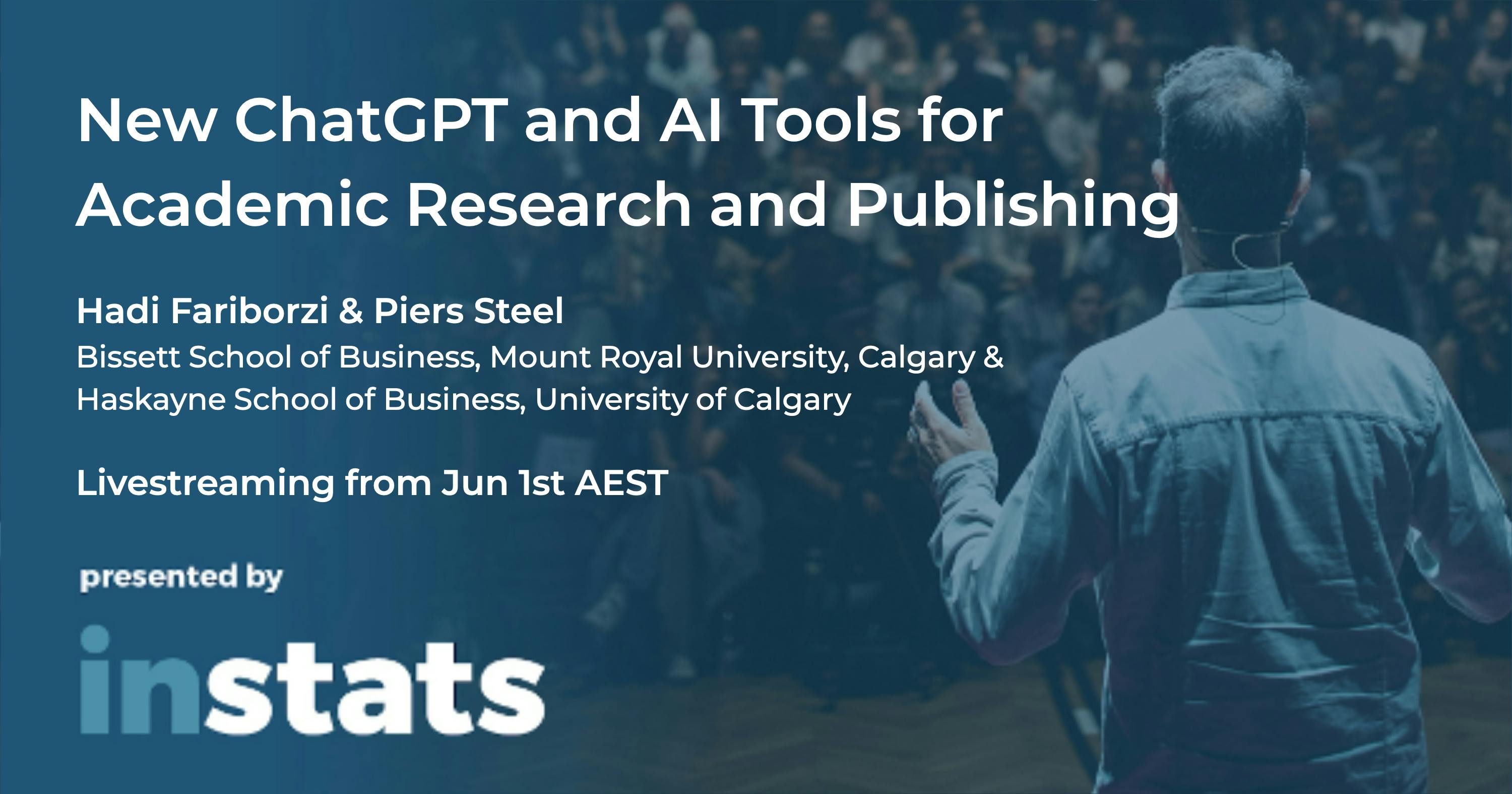
New ChatGPT and AI Tools
for Academic Research and Publishing
 Hadi Fariborzi Assistant Professor of Innovation and Entrepreneurship Bissett School of Business, Mount Royal University, Calgary |  Piers Steel Professor and Brookfield Research Chair Haskayne School of Business, University of Calgary |
Join professors Piers Steel and Hadi Fariborzi for a new seminar that covers recent developments in generative AI for academic research and publishing. This half-day seminar offers both newcomers and experienced AI users an unparalleled opportunity to quickly up-skill and re-skill by incorporating the latest AI advancements into the academic research and publishing process.
Register for this seminar to stay at the forefront of academic innovation, effortlessly integrating the newest AI tools and techniques as digital research assistants for your scholarly work.
📅 Date: Live Session Begins May 31, 2024
⏰ Time: Live streaming 1-Day Seminar
🌅 Day 1: May 31st from 7:30 pm to 11:30 pm*
*All times are in your local time zone.
📍 Location/Online Platform: The live-stream sessions are done on Zoom
🪑 Secure your spot now and mark your calendar for an enlightening experience you won't want to miss!
Reminder: The Open Source Initiative (OSI) invites the Python community to participate global in the conversation to find the definition of Open Source AI. #PyConUS#OpenSource
— Open Source Initiative @[email protected] (@OpenSourceOrg)
9:17 PM • May 16, 2024
📢Call For Papers: 3rd Zurich Workshop in AI+Economics📢
Conf: Dec 6th-7th, 2024 in Zurich
Papers due: July 19th, 2024Keynote by: @MelissaLDell
Submit here: forms.gle/wSSC3U9NDRfyDH…
More details: ethz.ch/content/dam/et…co-organized with
@ellliottt
@YanagizawaD— S Galletta (@sergallet)
7:52 AM • May 17, 2024
And that's a wrap for this edition of our AI Newsletter! We've covered a lot of ground, but remember, the adventure doesn't stop here. Keep exploring, keep learning, and keep pushing the boundaries of what's possible with AI. Together, we're shaping the future of academia one breakthrough at a time. Until next time, stay curious and keep shining bright! ✨. If you want to contact editorial team for having your news, tool, website, X page, or even yourself! introduced in our newsletter you can find contact info just below.
Reply